

You just walked away from a crash. You feel okay – shaken, maybe a little sore, but okay. So you wonder: do I really need to see a chiropractor after a car accident right now?
The short answer? Yes – and the sooner, the better.
At DeCarlo Chiropractic, we see this all the time. People wait days, even weeks, before coming in. By then, what started as minor stiffness has quietly turned into a bigger problem. We want to help you avoid that. This guide breaks down exactly what’s happening in your body after a crash and why acting fast makes all the difference.
Why You May Not Feel Pain Immediately After a Car Accident
Adrenaline Can Mask Injury Symptoms
Right after a collision, your body floods with adrenaline. This is your built-in survival response – it sharpens your focus and numbs pain so you can act quickly. The problem? It can completely hide real injuries for hours, sometimes days.
Dr. Joseph Horrigan, writing in The Physician and Sportsmedicine Journal, notes that soft tissue injuries are routinely underestimated in the immediate post-accident period because of how the nervous system responds to trauma. Don’t let a temporary absence of pain fool you into skipping care.
Delayed Onset of Whiplash and Soft Tissue Injuries
Whiplash is the most common injury we treat after auto accidents and it almost never shows up right away. The inflammation and muscle tension that cause pain tend to build gradually over 24 to 72 hours.
Watch out for these delayed warning signs:
- Neck pain and stiffness — worsening tightness or a limited range of motion
- Headaches and dizziness — often caused by cervical spine misalignment
- Shoulder and upper back pain — a telltale sign of whiplash-related muscle strain
Just because you felt fine at the scene doesn’t mean you’re in the clear.
Signs You Should Seek Care Immediately as a Chiropractor After a Car Accident
Some symptoms shouldn’t wait. If you experience any of the following after a collision, come in right away – don’t take a “wait and see” approach.
Neck or Back Pain
Any acute pain along the spine is a red flag. The impact from even a low-speed crash can shift vertebrae out of alignment, compressing nerves and surrounding tissues.
Headaches or Dizziness
Post-accident headaches are often linked to cervical spine stress, not just tension. Dizziness can signal inner ear disruption or nerve irritation at the top of the spine.
Numbness or Tingling
Radiating sensations down your arms or legs usually mean a nerve is being compressed somewhere in your spinal column. This needs prompt evaluation.
Limited Range of Motion
Struggling to turn your head or bend forward? That’s inflammation and muscle guarding at work. The longer it sits untreated, the harder it becomes to reverse.
How Chiropractic Care Helps After an Auto Accident
Spinal Alignment and Joint Function
After a crash, vertebrae can shift just enough to interfere with normal joint movement and nerve signaling. Chiropractic adjustments gently restore proper alignment, taking pressure off affected nerves and allowing the body to heal correctly.
A 2013 study published in the Journal of Orthopaedic & Sports Physical Therapy by Dr. Gwendolyn Sowa found that early spinal manipulation significantly reduced pain severity and recovery time in whiplash patients compared to delayed treatment.
Soft Tissue Recovery
Muscles, ligaments, and tendons take a serious hit in a collision. We use targeted soft tissue therapies alongside adjustments to reduce scar tissue formation and restore normal muscle function – before the damage becomes chronic.
Reducing Inflammation and Restoring Mobility
Here’s something most people don’t know: chiropractic adjustments help reduce the body’s inflammatory response. Research by Dr. James Whedon, published in the Journal of Manipulative and Physiological Therapeutics, found measurable reductions in inflammatory markers following spinal manipulation. Less inflammation means less pain and faster recovery.
Is It Ever Too Late to Start Treatment?
Managing Delayed Symptoms
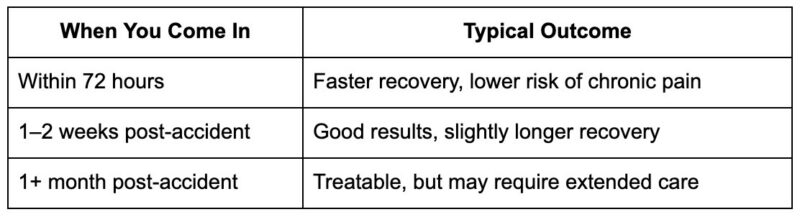
If a week or two has passed since your accident, don’t assume it’s too late. We still encourage you to come in. Delayed care is better than no care but the window for preventing long-term issues does narrow over time.
Treatment for Chronic Accident Injuries
Some patients come to us months after an accident, still dealing with persistent neck pain, headaches, or stiffness. Chronic accident injuries are absolutely treatable with chiropractic care, though the process is longer and more involved. This is exactly why early intervention saves you time, money, and discomfort down the road.
Schedule an Evaluation With a Chiropractor in New City, NY
Why Early Care Matters After an Accident
Here’s the bottom line: seeing a chiropractor after a car accident early isn’t about being overly cautious. It’s about catching hidden injuries before they become chronic conditions that disrupt your life for months or years.
At DeCarlo Chiropractic, we specialize in post-accident care. We’ll evaluate your spine, identify any injury whether you feel it yet or not and build a personalized recovery plan to get you back to 100%.
Don’t wait for the pain to get worse. Call us today or walk in – we’re here to help.
See more: Chiropractic Care for Whiplash: Treatments, Benefits, and Recovery Timeline
FAQs
Should I See a Chiropractor After a Minor Accident?
Yes. Minor accidents can still cause significant soft tissue injuries that don’t show up immediately. Even a low-speed rear-end collision generates enough force to strain the cervical spine.
Can Symptoms Appear Days Later?
Absolutely. Whiplash symptoms commonly peak 24–72 hours post-accident. Headaches, neck stiffness, and shoulder pain may not appear until day two or three.
Do I Need a Referral in New York?
No referral is needed to see a chiropractor in New York State. You can contact us directly and book an evaluation right away.
How Long Does Recovery Take?
Recovery time depends on the severity of your injuries and how quickly you seek care. Many patients see significant improvement within a few weeks of consistent treatment. Delayed cases may take longer.